

Editorial · The case for a disciplined Bitcoin allocation
Most people don't lose money on Bitcoin because of Bitcoin. They lose it because they never decided how much to own.
Ask ten Bitcoin holders what their target allocation is and you'll get ten blank stares. Most didn't choose a number — they bought an amount that felt exciting in a bull market and have been white-knuckling it ever since.
That's the real problem. Bitcoin's volatility is not a bug you can wish away; drawdowns of 70–80% have happened more than once and will almost certainly happen again. An asset that can fall that far is survivable only if you've sized it deliberately — small enough that a brutal year doesn't force you to sell at the bottom, large enough that a good decade actually moves your net worth.
But there's one thing that separates the investors who stay the course from the ones who panic: they treat allocation as a decision made in advance, in writing, while calm — not a reaction made mid-crash while scrolling at 2am.
That decision has three parts: how much to hold, how to hold it, and when to rebalance. Get those right and Bitcoin becomes a position you can actually live with. Get them wrong and even a winning asset becomes a losing experience.
Is now a good time to add Bitcoin to a portfolio?
The honest answer is that "timing" matters far less than sizing for a long-horizon allocation — and the people who run real money increasingly say so out loud.
BlackRock CEO Larry Fink has publicly described Bitcoin as "an international asset" and a legitimate instrument that investors can use to diversify, a notable shift from his earlier skepticism. Fidelity's research arm has gone further, publishing analysis arguing that even a small, deliberate allocation can be considered by long-term investors who understand the volatility.
Paul Tudor Jones, the macro investor, has framed his own position around inflation hedging rather than speculation — owning a measured slice as insurance against monetary debasement rather than betting the farm. What these voices share isn't a price target; it's a posture: small, intentional, and rules-based.
The market data backs the "size it, don't time it" view. According to Bloomberg's ETF data, U.S. spot Bitcoin ETFs absorbed tens of billions of dollars in net inflows in their first year after launching in January 2024 — one of the most successful ETF debuts on record. Analysis cited by JPMorgan has repeatedly noted that Bitcoin's correlation to equities shifts over time, which is precisely why a fixed-rule allocation outperforms gut-feel trading for most people.
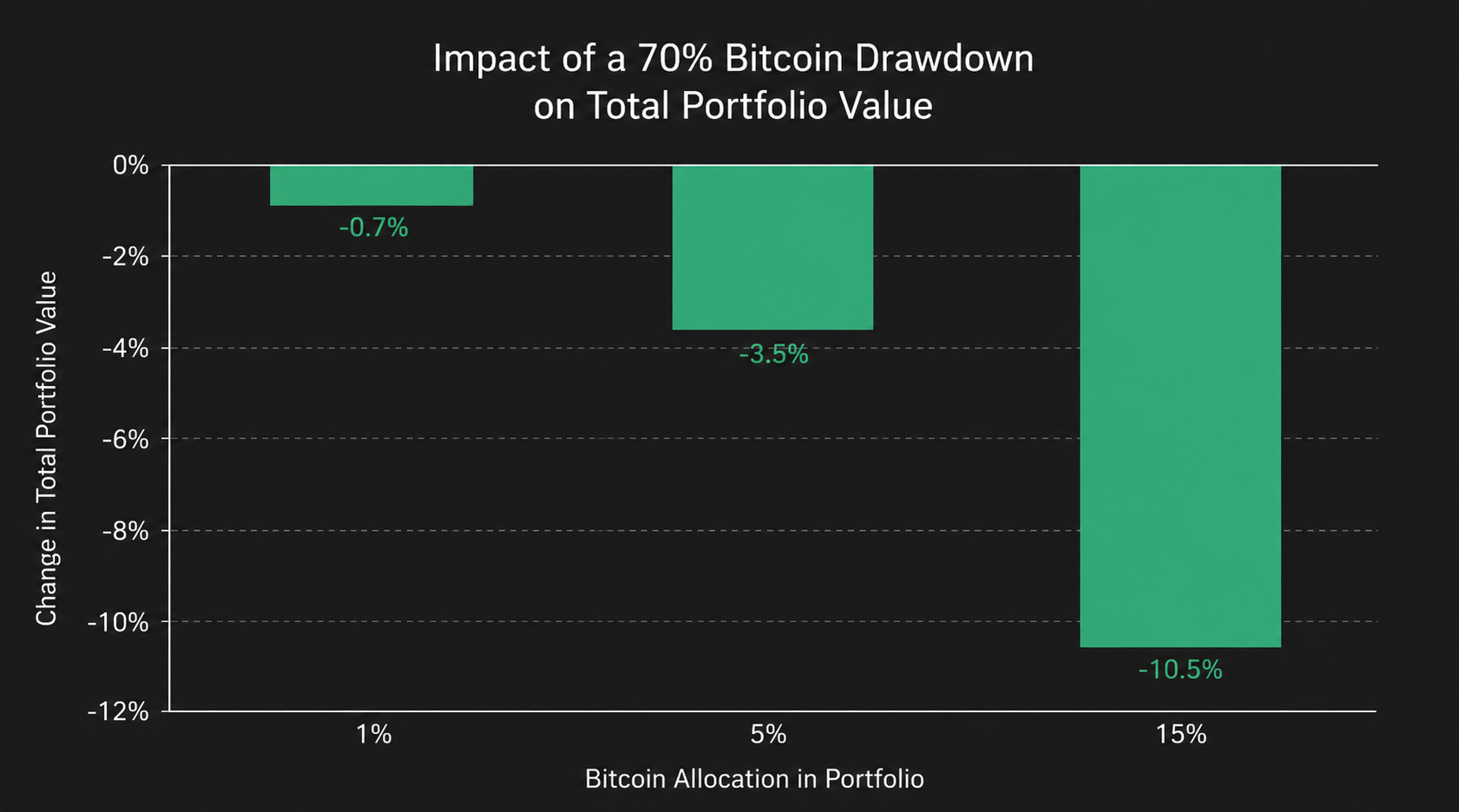
History offers a useful parallel. When gold was first made easily ownable by mainstream investors through ETFs in the mid-2000s, the early debate sounded identical: too volatile, no cash flow, purely speculative. What changed wasn't the asset — it was that investors learned to size it as a small, rules-based slice of a diversified portfolio rather than an all-or-nothing bet.
Bitcoin is walking the same path now. The infrastructure (regulated custody, ETFs, clearer tax guidance) has caught up faster than most people realize. The investors getting hurt today are rarely the ones who own a disciplined 2–5% — they're the ones who went all-in at the top with no plan for the inevitable drawdown.
If you'd like to understand the full framework — including the specific sizing model, custody decision tree, and tax considerations — read the full guide below. It's a 168-page guide built from years of working through these exact questions with serious, long-horizon investors.
None of this requires you to believe Bitcoin is going to a particular number. It only requires you to decide, calmly and in advance, what role a volatile, uncorrelated asset should play in your portfolio — and then to hold the line when the market tests your conviction.
That's the whole game. Not prediction. Discipline. The investors who win with Bitcoin over a decade are almost never the ones who were loudest at the top — they're the ones who picked a number, held it safely, and rebalanced without drama.